
The Tiny Body Part with a Big Impact on Balance
Have you ever felt like the room was spinning, even though you were standing still? Or maybe you’ve had a “floaty” feeling that makes you hesitate to move too quickly. What if I told you that a collection of tiny crystals deep inside your head is responsible for you knowing whether you’re right-side up or not?
Yes, it sounds strange. But it’s true! The crystals are part of your inner ear, a dime-sized structure that plays a key role in helping you stay balanced and knowing which way is up, down, or sideways. It quietly works all day, every day, to help you walk, turn your head, and move without losing your balance. Your inner ear also helps you hear, but today we’re going to focus on its role in balance and keeping you steady.
How the Inner Ear Keeps You Steady
Your vestibular system, located in the inner ear, is made up of three tiny, fluid-filled semicircular canals and two small organs called the saccule and utricle. Inside the saccule and utricle are those crystal-like particles called otoconia.
The semicircular canals sense when you turn or tilt your head. The utricle and saccule detect movements like going up and down in an elevator or moving forward in a car.
When you move, tiny hair cells in these structures bend and send signals through the vestibulocochlear nerve to your brain. This tells your brain where your body is in space—essentially, which way is “up and down.”
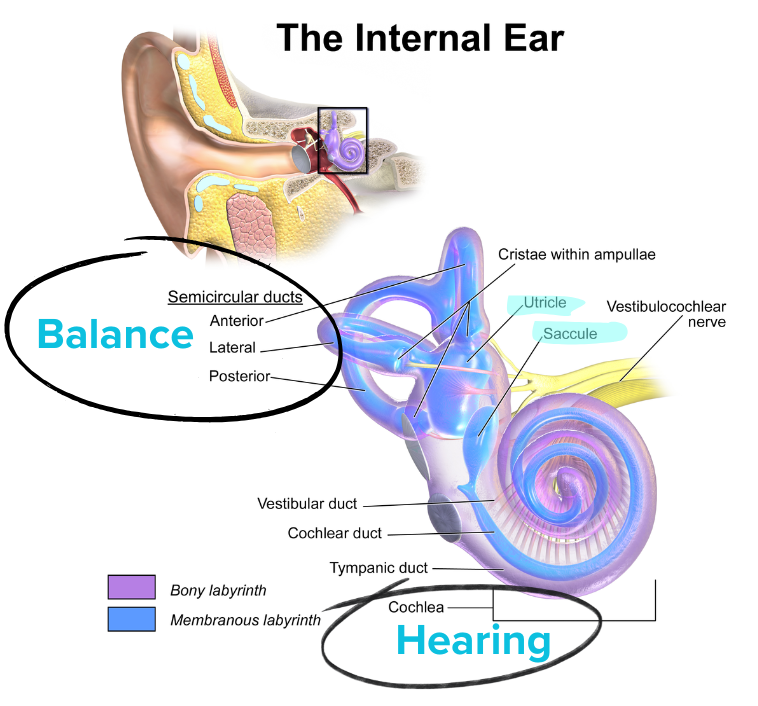
Your inner ear is smaller than a dime, but it’s filled with tiny organs that help you stay balanced and steady.
(Image credit: Blausen.com staff (2014). "Medical gallery of Blausen Medical 2014".
When Things Go Wrong
Sometimes those otoconia (the crystals) can become loose or dislodged. When that happens, your brain gets mixed signals about your position. You might feel dizzy, lightheaded, nauseous, or even like the room is spinning. In more severe cases, these symptoms can mimic a stroke. Many people describe it as feeling like they can’t trust their own body.
Even though it’s happening in your ear, you usually won’t feel ear pain. That’s because the problem isn’t with your hearing—it’s with how your brain and inner ear are communicating about balance.
How Vestibular Rehabilitation Therapy (VRT) Can Help
If you make an appointment because you’re feeling dizzy or off-balance, we’ll look at how your eyes, ears, neck, and muscles are working together. From there, we’ll design a custom vestibular rehabilitation program to retrain your brain and body to communicate properly again. VRT uses gentle, targeted exercises, that can help your system relearn how to interpret signals correctly—reducing dizziness, improve balance and helping you regain your confidence in movement. When you come in, we’ll take time to understand your symptoms and how they affect your daily life. We’ll look at how your eyes, ears, neck, and muscles are all working together, then build a plan that’s designed just for you.
A Personal Note
Helping people feel balanced and steady again is one my of passions—not just because it’s part of my profession, but because I know how deeply these symptoms can affect your life and the frustrations that come with them.
If you’ve been struggling with dizziness, unsteadiness, or that unsettling “off” feeling, please know you’re not alone—and it’s not something you just have to live with. Schedule an appointment to see if vestibular rehabilitation therapy can help you get back to feeling balanced and in control.